Xposure 2026
← Guests
Ghada Al Qasimi
"The photograph does not necessarily say what is no longer, but only and for certain what has been”. Ronald Barthes in Camera Lucida.
Ghada Ahmed Al Qasimi is an Emirati photographer whose work explores memory, emotional experience, and the quiet presence of loss and absence. Her images dwell in moments where words fall short, holding fragments of feeling, silence, and reflection. Through a contemplative visual language, she examines how photographs can preserve what lingers beneath the surface, whether personal history, grief, or traces of time suspended. Her practice invites viewers into intimate spaces shaped by remembrance, vulnerability, and emotional depth.
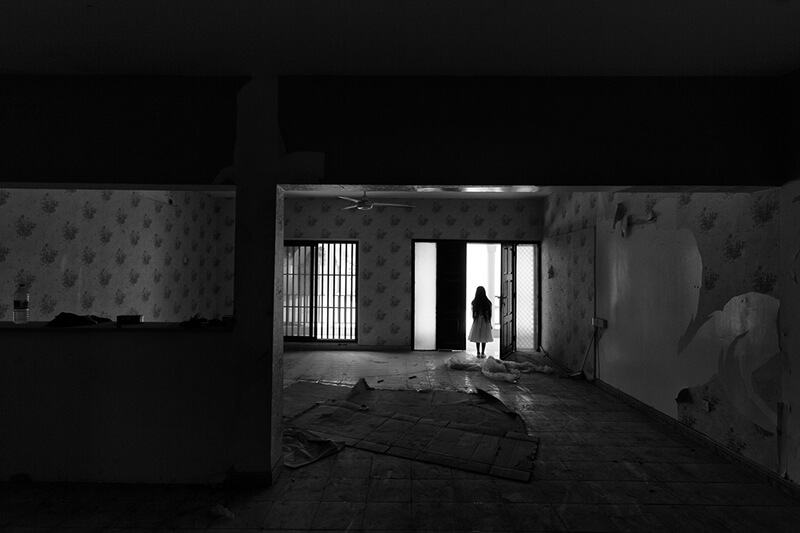
Her artistic approach is rooted in the belief that photography can articulate what remains unspoken. She treats images as emotional containers rather than explanatory statements, allowing ambiguity to play a central role. This philosophy is evident in her Grandma series, where she turns inward to examine family memory and the subtle imprints of grief. Rather than documenting events directly, she traces the emotional residue left behind, creating work that resonates through suggestion, absence, and atmosphere.
Influenced by Alec Soth’s understanding of photography as performance, Al Qasimi builds sequences that function rhythmically. Each image becomes a gesture, a clue, or an emotional marker, forming narratives that the viewer must slowly assemble.
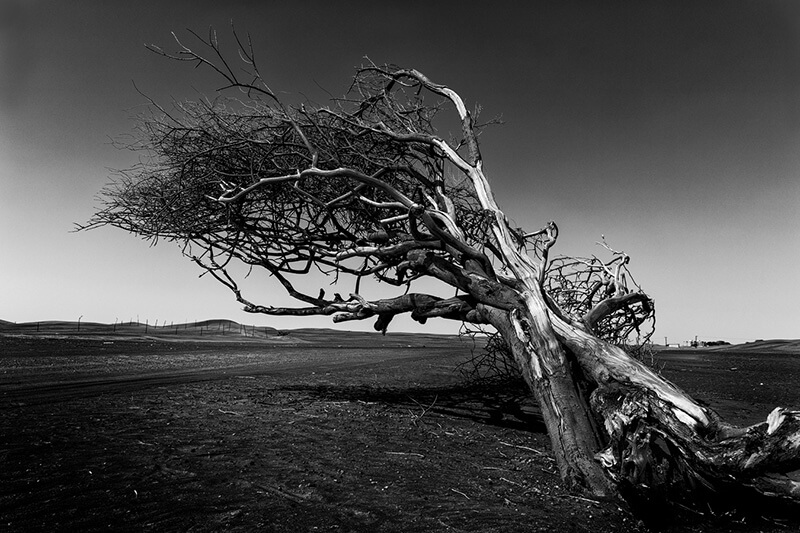
In her Silence series, Ghada Ahmed Al Qasimi shifts her focus toward landscape and the philosophy of the sublime. Drawing on Edmund Burke’s belief that fear, loss, and the unknown move us more deeply than beauty alone, she photographs nature as a force that exists beyond human control. Her images emphasise scale, stillness, and emotional tension, where the vastness of the natural world confronts human fragility.
Across her practice, Al Qasimi constructs visual narratives that operate through mood rather than resolution. Whether working with personal memory or expansive landscapes, she allows meaning to emerge gradually, through repetition, quiet detail, and emotional resonance. Her photographs do not demand interpretation but encourage reflection, inviting viewers to sit with uncertainty, memory, and the passing of time.
Through this sustained engagement with inner and outer worlds, her work reveals how photography can serve as a space for contemplation, balancing presence and absence.